
Basic Music Theory for IIDX Players (Tempo, Time Signatures, and Intervals)
SP Intermediate
SP Advanced
Table of contents
- Before we begin
- Why do I need to know this?
- Basics
- In practice
- Polyrhythm
- IIDX songs that do not use 4/4
- Further reading
Before we begin
This is meant to be an extremely simplified explanation of basic music theory concepts for IIDX players.
It’s assumed that you don’t know how to read sheet music. If you do, then you already know the first half of this page.
If you want to learn more about this topic, you can start with material suggested in the Further Reading section at the bottom of this page. I would also encourage doing your own research and branching out to more advanced topics; there are a LOT of good videos on YouTube on this topic.
Why do I need to know this?
Understanding basic music theory is not a requirement to get good at IIDX, but it will help with:
- improving your timing
- establishing a common language and terminology that are understood by many (e.g., these are 8th note scratches, this song is on 12/8 time, 16th note trills)
- gaining more appreciation for how game music is crafted
Basics
Bars (Measures) and Bar Lines
In music, a measure (or bar) is a small segment of notes and rests. Measures in a piece of music have equal length, assuming that tempo remains the same.
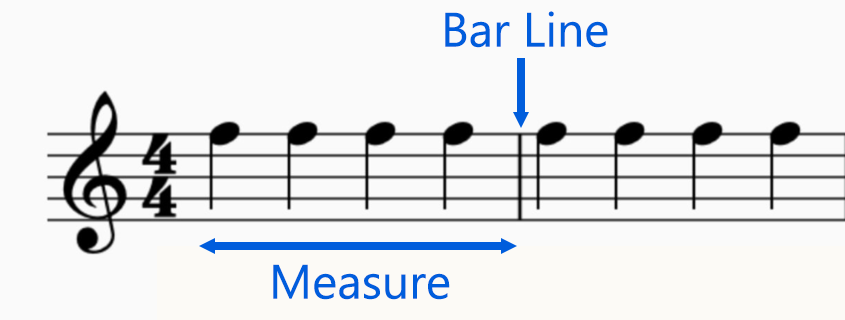
IIDX has the same concepts, though rotated. Horizontal lines are bar lines, and the section between bar lines is a measure. Let’s take the beginning of Quasar SPH as an example.
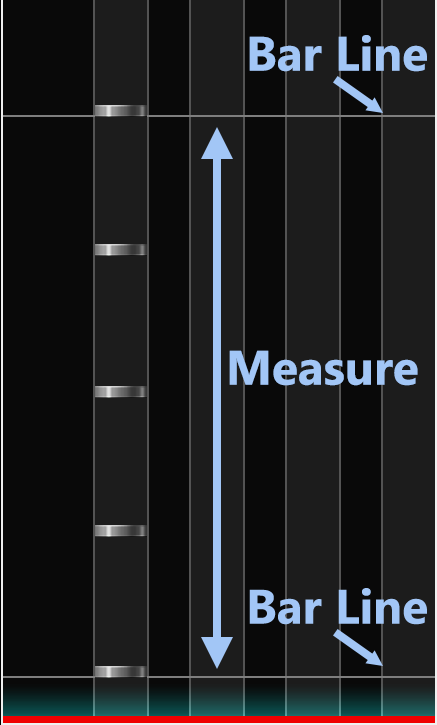
(For illustration purposes, hi-speed setting was set to the lowest in order to fit a measure on your screen).
Quarter notes (beats in 4/4)
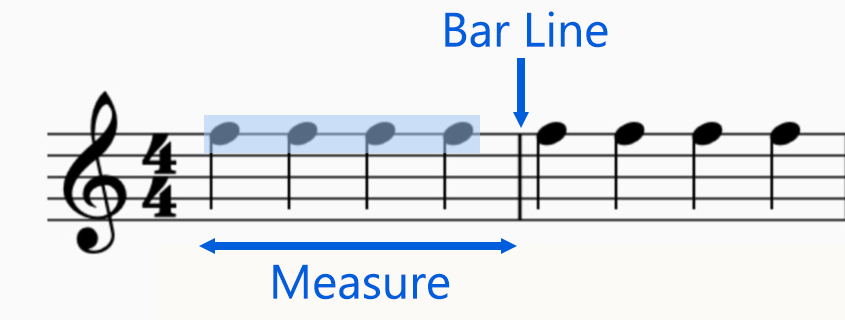
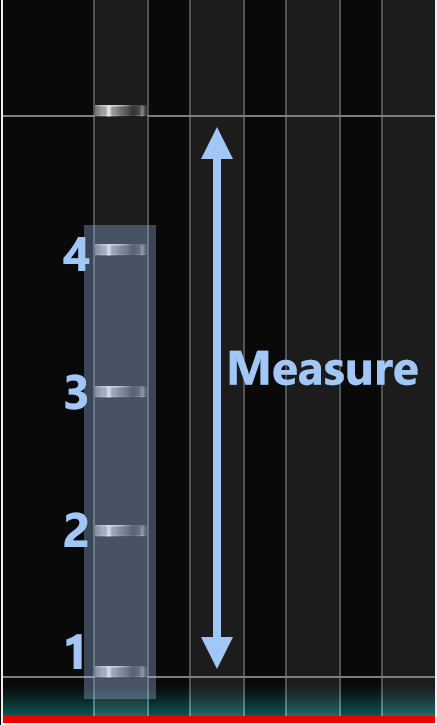
Here, we see that there are four notes in a measure in the beginning of Quasar SPH, each making a strong drum sound. As these notes evenly divide the measure into quarters, we call them quarter notes (1/4).
We can also call them beats as they are the basis of the rhythm. Here, we have four beats per measure.
Tempo, BPM (Beats Per Minute)
Tempo is simply the speed of music. We can measure this with Beats Per Minute (BPM); how many beats there are in 60 seconds. IIDX uses BPM as well; it is displayed in the song select screen and in the play screen.
Quasar SPH is 155 BPM.
Time signatures
Time signatures indicate how many beats fit into a measure.
Quasar uses 4/4. The top number (4) means four of, and bottom number (/4) means quarter notes; adding them together, it means four quarter notes per measure.
4/4 is the most common time signature, the majority of music you listen to will use 4/4. This also applies to IIDX; most charts in IIDX are 4/4. There are other time signatures, of course, but we will talk about them later.
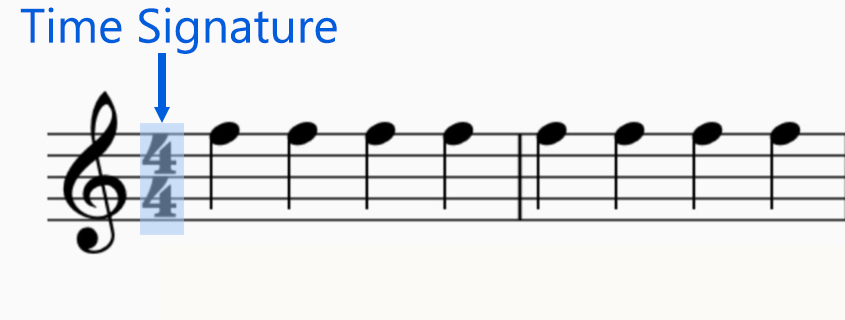
This information is not displayed in the game, but the game does keep track of it internally.
Intervals
Eighth notes
If four notes per measure are 1/4 notes, what about faster (shorter, more frequent) notes? How about 8 notes per measure?
Eighth notes are twice as fast than quarter notes. In IIDX, this means the gaps between notes are half as wide.
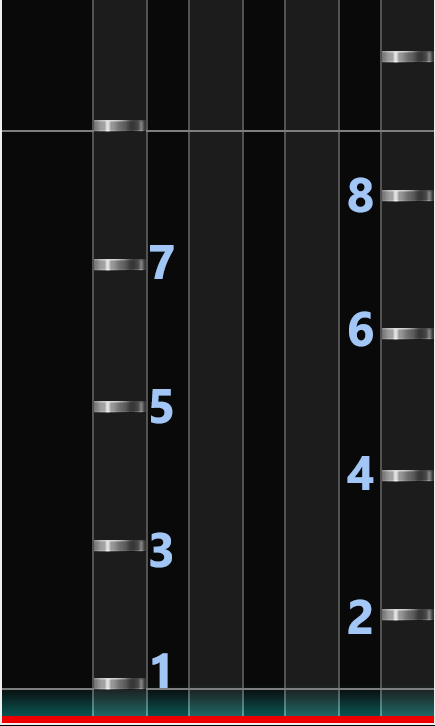
In the beginning of quasar, button 1 makes the strong drum sound (dumm / downbeat), and button 7 makes the weak drum sound (tss / upbeat). These eighth notes evenly divide up a measure into eight parts.
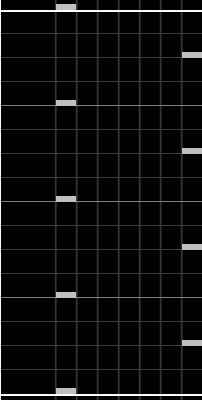
Above is a screenshot of the same measure on Textage, a database of IIDX charts. On this site, each measure has faint lines dividing up a measure into 16 equal-sized sections. You can see that each note aligns up with every 1/8 division.
Sixteenth notes
What about 16 notes per measure?
We do the same as before; twice as fast compared to eighth notes, which means half as wide gaps between notes. These notes evenly divide the measure into 16 parts.

Looking at the textage output on the right, you can see that each note takes up one 1/16 division.
What if there are rests in between?
A measure can have rests (pauses), where there is no note. Rests have durations too, just like notes.
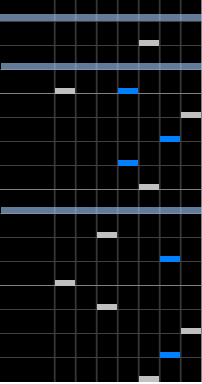
There are three rests and 13 notes (the second last note is a chord, we’re grouping them as one since we are only talking about rhythm here). Each rest is a sixteenth rest in this measure. Each note is still a sixteenth note.
Going further
Doing one more “halving” of the gaps between, we would reach 32nd notes. We don’t typically talk about anything beyond that.
Non-4/4 beats
The world would be a boring place if music only had notes that are powers-of-two.
Let’s imagine twelve notes per measure. These would typically show up in songs with different time signature, but that’s not a requirement. These are called twelfth notes.
GRID KNIGHT is a good example. Here is a measure from the Hyper:
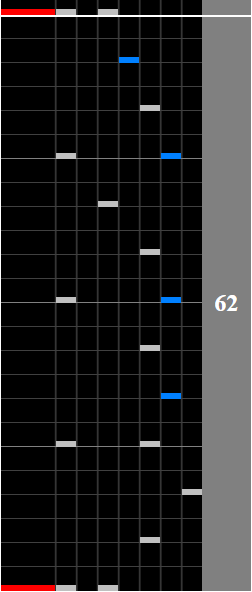
Here, you can see that there twelve evenly-spaced notes in one measure. In fact, Textage helpfully draws lines dividing each measure into 24 sections.
Something noteworthy is lane 1, which makes a strong drum sound. This is the down beat - there are four of them in a measure (dum, dum, dum, dum). Rest of the lanes are the melody, and there are twelve of them in a measure - these are actually four triplets (TA-da-da TA-da-da TA-da-da TA-da-da).
GRID KNIGHT operates on this rhythm of 12 notes per measure, which makes this a 12/8 time signature (each measure has twelve 1/8 notes). You don’t need to understand time signatures right away; you just need to understand that this is not a 4/4 time signature, and therefore sounds and plays differently; watching the video probably already gave you that feeling.
If you want to learn more about time signatures other than 4/4, check out videos in the Further Reading section.
Aren’t the real “speed” of notes relative to the BPM?
Yes! A series of sixteenth notes at 150 BPM would be much slower than, say, 200 BPM, since the overall music would be playing at a faster rate.
Also, similarly important math: sixteenth notes at 150 BPM would be the same speed as eighth notes at 300 BPM, and so on.
Aren’t the gaps between notes relative to your green number / HI-SPEED setting?
Yes, of course! Now you’re getting it!
The number of pixels in the gap between the notes are relative to your settings. The gap between two quarter notes would be significantly wider if your green number was lower (if your hi-speed setting was higher) or if your white number was lower (smaller lane cover).
This is why it’s important to keep your green & white numbers consistent once you find a comfortable setting. When you are used to the game, the size of the gap between notes indicate to you the current rhythm of the notes!
Conversely, this is (one of the reasons) why it’s difficult to deal with soflan songs when the green number changes. If the green number changes & you are faced with a different set of gaps, you are unable to determine the timing of the notes.
In other words, hi-speed settings aren’t just adjusting how fast the notes travel on the screen, it also adjusts the size of the gaps between notes. IIDX isn’t a reaction time measurement contest, it’s a rhythm game after all.
In practice
Notes
PENDULUMs
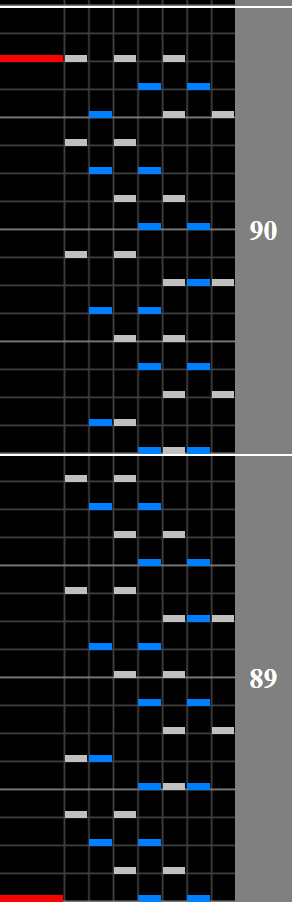
The chord streams at the end of Chrono Diver PENDULUMs SPA are just a series of chords at 1/16… at 196 BPM. Good luck. When people talk about “BMS-style chord streams” they mean this - sixteenth note streams.
Diavolo
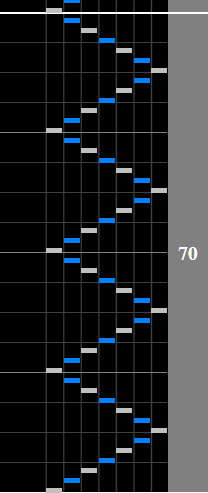
The end part of Diavolo is technically 1/48 at 160 BPM, but as humans it’s really difficult to grasp how fast that is, so we don’t really bother.
What does help is understanding that the “end” notes in lane 1 and 7 appear every 1/8.
超青少年 (Very Juvenile)
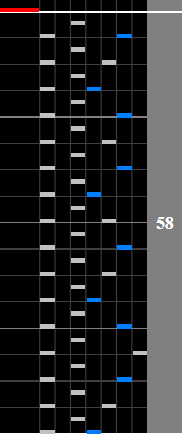
超青少年ノ為ノ超多幸ナ超古典的超舞曲 SPL measure 58. The trill on the left side is 1/32; melody on the right four lanes are 1/16.
Scratches
Plan 8

This is measures 63-64 in Plan 8 SPA, the fast scratching section right before the break in the middle.
Looking at the textage output, you can see that the scratches are exactly 1/16.
Polyrhythm
Polyrhythm is when two or more rhythms are used at the same time.
It would be not as interesting if there are two rhythms and they’re multiples of each other (1/4 and 1/8); usually, we are talking about combining different beats like 1/4 and 1/6.
gigadelic
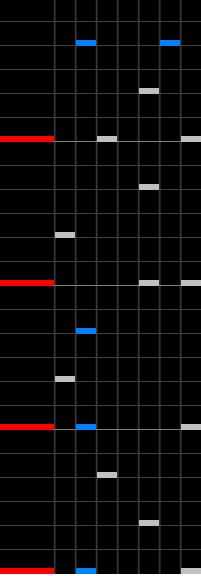
Above is measure 79 of gigadelic hyper. The scratches are 1/4, but the notes are 1/12. This is one of the reasons for people finding the end of gigadelic to be so difficult.
Ganymede
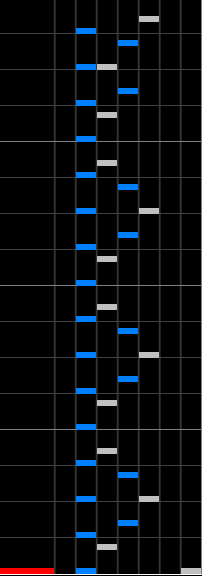
Above is measure 27 of Ganymede SPA. Ganymede is 4/4, so Textage helpfully divides up each measure into 16 sections.
You can see that notes in the second lane lines up with the 16 sections, making them sixteenth notes. However, the other lanes are slightly off - it’s because they are 24th notes (there are some pauses in between - they are 24th rests!).
Video is here if you want to listen to it, linked to 1:55.
IIDX songs that do not use 4/4
3/4
You probably expected the waltz (valse) songs to be in 3/4, but a lot of people don’t realize Element of SPADA is also a great example of 3/4.
6/8
- [HARD IRISH SYMPHONIC] Despair of ELFERIA (linked to the hyper since the another has way too many notes and hard to follow).
12/8
Typically expressed as 4 sets of triplets,, which gives the songs a “bouncy” feeling or a “shuffle”.
L.E.D. has a handful of these.
More complex examples (for fun)
- [SWING WALTZ] garden and the corresponding sheet music; 95jack expressed this as 3/4 and 5/4.
- [DARK PROGRESSIVE] DAY DREAM is mostly in 17/16; Mutsuhiko Izumi is known to experiment with odd time signatures.
- [HARD TECHNO] Holic is apparently 7/8 in the beginning, 7/4 in the middle, and ends on 4/4.
- [SYNTHETIC PROGRESSIVE ROCK] 100% minimoo-g so all over the place that Konami just gave up and hid the bar lines entirely.